
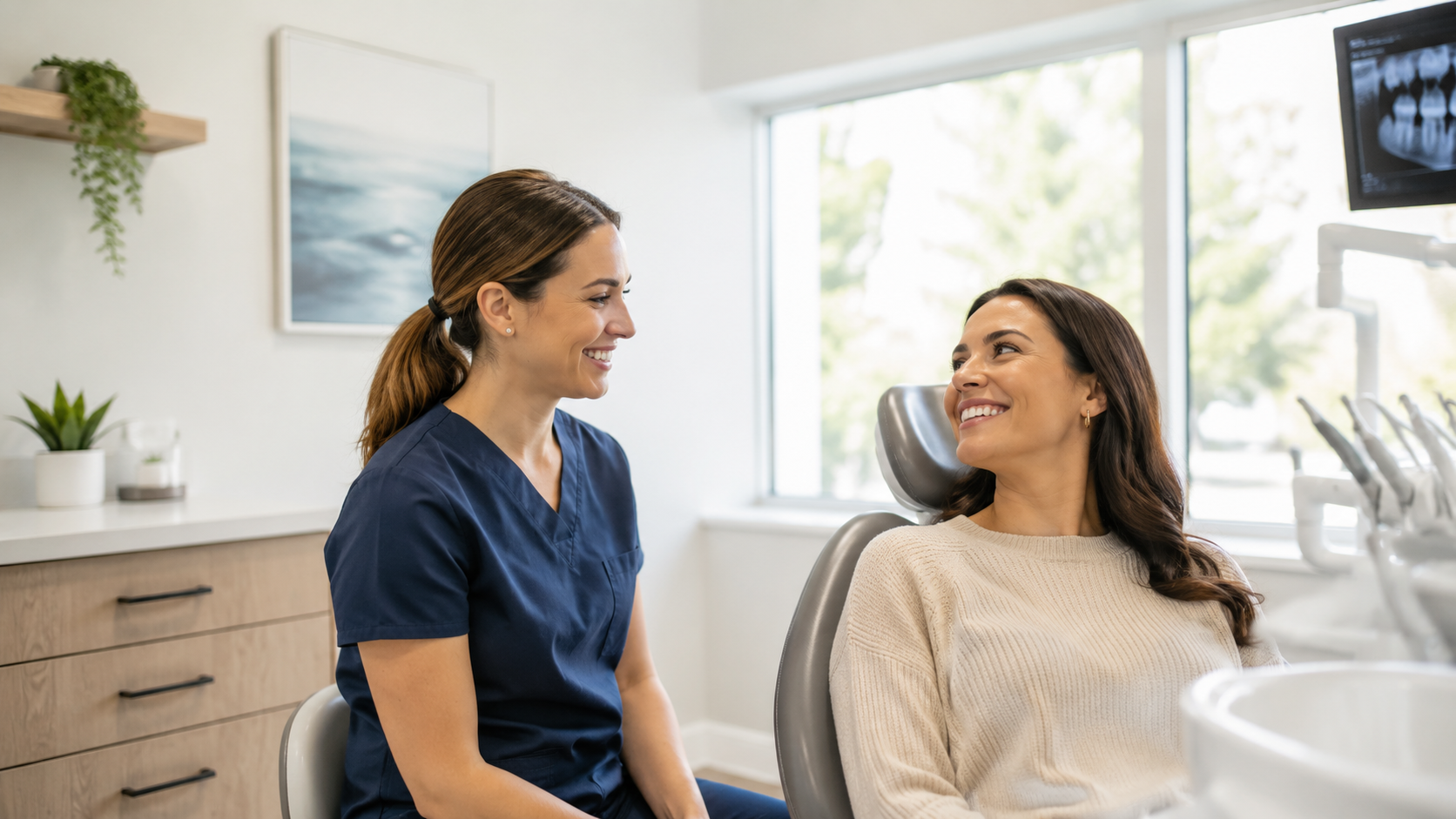
You’ll discover how Invisalign uses clear, removable aligners and digital planning to straighten teeth with less discomfort and more convenience than many traditional options. Invisalign can give you a discreet, predictable path to a straighter smile while letting you eat, brush, and live normally during treatment.
They’ll explain how aligners work, the tech behind virtual treatment plans, and the real benefits patients notice — from improved oral hygiene to fewer emergency visits. Expect a practical guide that helps you weigh comfort, outcomes, and suitability so you can decide whether Invisalign fits your life and goals.
Invisalign uses a sequence of precisely made, removable plastic trays to move teeth in planned stages. The process combines digital scanning, custom appliance fabrication, and regular monitoring to deliver predictable tooth movement with fewer in-office adjustments.
The dentist or orthodontist begins with a digital scan or physical impressions to capture the patient’s current bite and tooth positions. These scans create a 3D model used in treatment planning software to map each tooth’s movement from start to finish.
The clinician sets goals in the software — for example, closing a 2 mm gap or rotating a canine 15 degrees — and the system generates a series of aligner shapes. Each aligner applies specific pressure points; small attachments (composite bumps) may be bonded to teeth to improve grip or direct force.
The lab fabricates aligners from medical-grade, BPA-free thermoplastic using the digital models. The result: a snug, custom-fit tray for each step of the plan that patients wear at home according to prescribed hours.
Most treatment plans last 6–18 months, though simple cases can finish in a few months and complex cases may take longer. Patients typically wear aligners 20–22 hours per day and switch to the next tray every 1–2 weeks, depending on the clinician’s instructions.
Clinicians schedule periodic check-ins every 6–12 weeks to confirm movement, adjust staging if needed, and deliver additional aligners. Many practices use remote monitoring tools—photos or dedicated apps—to track progress between visits and reduce unnecessary office time.
Compliance and timely follow-up strictly affect outcome. If a patient misses wear time or skips monitoring visits, tooth movement can stall and the overall timeline can extend.
Each aligner is engineered to move teeth a small, controlled amount—typically 0.1–0.25 mm of translation or a few degrees of rotation per stage. The plastic applies light, continuous forces to the tooth root and periodontal ligament, prompting bone remodeling that allows the tooth to shift.
When a tooth moves into its new position, the periodontal ligament and surrounding bone adapt; the next aligner continues this progression. Attachments and interproximal reduction (slenderizing enamel between teeth) are common auxiliary techniques used to gain space or improve torque.
If refinements are required near the end of treatment, the clinician scans the current result and designs additional aligners focused on stubborn movements. This iterative process keeps control precise and predictable while keeping patient comfort high.
If the patient completes active treatment, retainers prevent relapse by holding teeth in their new positions. The clinician specifies retainer type and wear schedule tailored to the patient’s final alignment and risk of movement.
Patients gain a combination of aesthetic, comfort, and lifestyle advantages that make orthodontic treatment less disruptive to daily life. Clear appearance, gentle tooth movement, and the ability to remove aligners for eating and hygiene rank highest for most people.
Invisalign aligners use clear, medical-grade thermoplastic that fits tightly over teeth, making them hard to see at conversational distance. Unlike metal brackets and wires, the aligners avoid visible hardware, which reduces social anxiety for adults and teens who prefer a more natural look.
The transparency also minimizes photographic contrast; patients often report feeling comfortable at work, school, or events without questions about braces. Providers can show simulated before-and-after images so patients understand expected aesthetic improvements during treatment.
Some cases require small composite attachments bonded to teeth to guide movement. These attachments are tooth-colored and less noticeable than brackets, and they are removed and polished once treatment ends.
Aligners are custom-scanned and 3D-printed to match a patient’s dental anatomy, which reduces sharp edges and pressure points common with traditional braces. The gradual, programmed tooth movements produce lighter forces delivered over each two-week aligner stage, often resulting in milder soreness.
Patients avoid wire pokes, bracket breaks, and emergency visits caused by loose hardware. Routine adjustments are replaced by scheduled aligner changes and occasional check-ins, which can mean fewer in-office visits and shorter appointment times.
Oral soft tissues—lips and cheeks—experience less irritation, and many patients adapt quickly to wearing aligners, finding them comfortable for speech after a few days. Nighttime grinding can be monitored; some clinicians provide protective options if bruxism is present.
Patients remove aligners to eat, drink anything other than water, and for oral hygiene, preserving normal dietary choices without food restrictions. This makes it simpler to maintain flossing and brushing habits, lowering plaque and decay risk compared with fixed appliances.
Removability supports special occasions—performing, public speaking, or photo sessions—without permanent hardware affecting appearance or comfort. Clinicians generally recommend wearing aligners 20–22 hours per day; adherence directly influences treatment speed and outcome.
When required, patients can remove aligners temporarily for sports or musical wind instruments, then resume wear. Clear, written schedules and reminder tools (apps or calendars) help patients meet wear-time targets and track progress between visits.
Invisalign combines precision scanning, digital planning, and specialized materials to move teeth predictably while prioritizing comfort. Each step—scanning, manufacturing, and material selection—affects fit, force delivery, and treatment efficiency.
Digital intraoral scanners capture high-resolution 3D models of the teeth and soft tissues within minutes, replacing messy putty impressions. The scanner creates a point-cloud that software converts into a detailed mesh; clinicians use that mesh to evaluate occlusion, measure tooth positions, and plan movements down to tenths of a millimeter.
Treatment planning occurs in the cloud with ClinCheck® or similar software. The dentist or orthodontist sequences individual tooth movements, sets attachments and IPR locations, and simulates timelines. This visual plan helps patients see expected outcomes and lets clinicians adjust biomechanics before any aligner is made.
Digital records also improve communication with labs and allow repeatable, archived datasets for progress checks. Scans integrate with CBCT or photos when needed for complex cases, supporting diagnoses like impacted teeth or airway concerns.
Once the digital plan finalizes, 3D printers produce precise models for each aligner stage. Printers use resin cured by light to reproduce the digital mesh with consistent layer thickness and dimensional accuracy, typically within a few tenths of a millimeter.
Technicians post-process models—washing, curing, and quality-checking—before thermoforming clear polymer sheets over the models. This thermoforming creates the intimate fit that transmits planned forces. Automatic trimming and polishing of aligners improve comfort at the gingival margin and reduce soft-tissue irritation.
Centralized digital workflows permit mass production without sacrificing customization. If an aligner needs adjustment, the practice can revise the digital plan and print a corrected model quickly, shortening turnaround for refinements.
SmartTrack is a proprietary, multilayer thermoplastic designed to deliver more constant, gentle forces compared with earlier rigid plastics. Its elasticity and stress-relaxation profile maintain force levels over the typical two-week wear cycle, which supports more predictable tooth movement.
The material provides a snug fit that increases aligner retention on teeth and reduces the need for frequent refinements. Patients notice smoother insertion and removal and fewer pressure spikes because SmartTrack adapts to small tooth positions while still returning to its original shape.
SmartTrack also balances clarity and strength; it resists staining better than many alternatives and retains transparency through several weeks of wear. Clinically, that means improved esthetics for patients and more consistent biomechanics for clinicians planning tooth movement.
Invisalign often reduces in-person time with the dentist and lets patients keep eating their normal foods more easily. It achieves this through removable aligners and a treatment plan driven by digital scanning.
Invisalign typically requires fewer adjustment appointments than metal braces. After the initial scan and fitting, patients usually receive multiple aligner sets to change at home every 1–2 weeks, cutting routine visits to every 6–10 weeks for progress checks rather than the 4-week tightening cycle common with braces.
Fewer visits matter for busy schedules and for patients who travel. Remote monitoring apps and periodic photos can let the orthodontist assess progress between visits, reducing unnecessary trips while still catching issues like poor fit or unexpected tooth movement.
Emergency visits are still possible with Invisalign — for lost or damaged trays, or if attachments dislodge — but they occur less often than emergency wire pokes or bracket failures with braces.
Invisalign aligners are removable, so patients usually can eat and drink without altering their diet. Foods that must be avoided with braces — sticky candies, hard nuts, whole apples — can be eaten normally after removing aligners and brushing before reinserting them.
This removability also lowers the risk of food getting trapped and causing decay around brackets. Patients must brush and floss after meals before putting aligners back in, which encourages better oral hygiene habits but requires discipline.
Soft drinks and highly acidic beverages still pose a risk if consumed while wearing aligners, because sugar and acid can sit against enamel under a tray. The provider will instruct patients to remove trays for eating and to rinse or brush before replacing them.